
Bringing the Physical Internet to life
On 18 February 2025, logistics and supply chain experts gathered ...


Automation Towards Multimodal Transportation and Integration of Freight
Advancing the integration and interoperability of automated transport systems to enable seamless, efficient and sustainable multimodal freight transport across Europe.
Ongoing
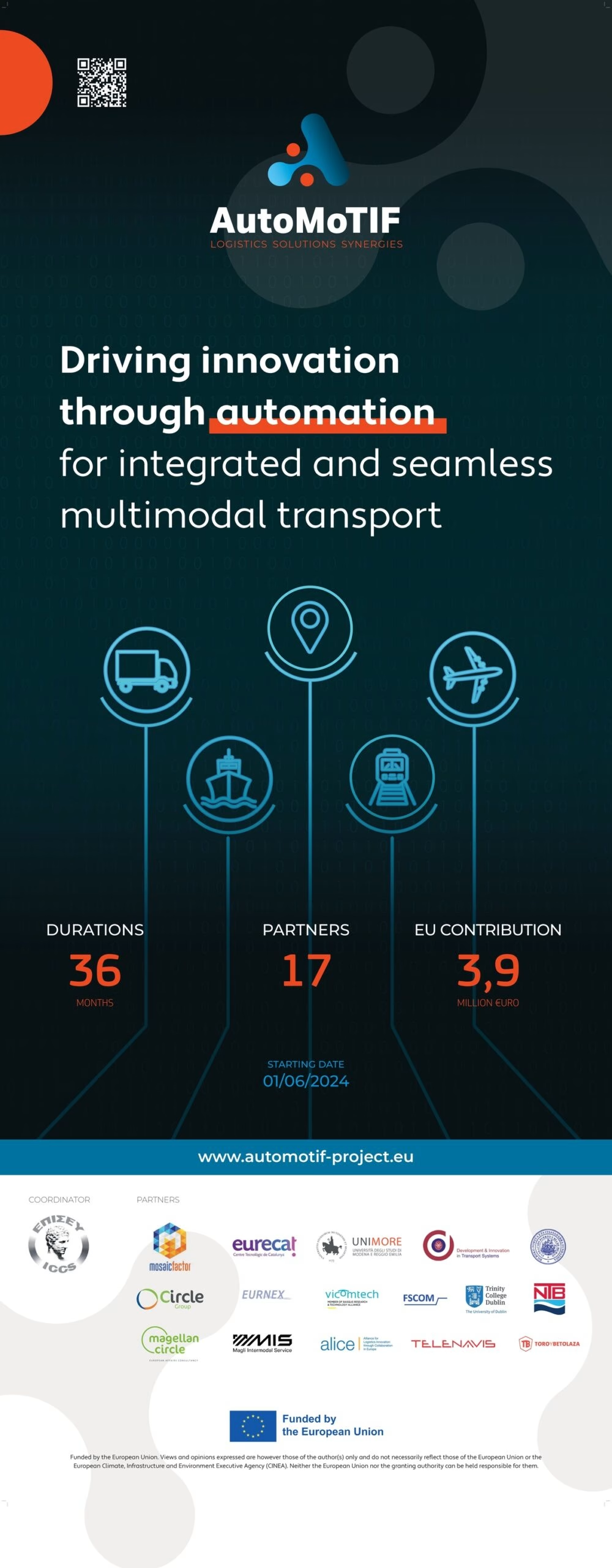
June 2024 - May 2027 (36 months)
Horizon Europe Research and Innovation Action (RIA)
101147693
????
The AUTOMOTIF project addresses one of the key challenges facing European freight transport: the lack of integration and interoperability between emerging automated transport technologies operating across different transport modes, terminals and logistics hubs.
While significant progress has been made in automating individual transport operations, most solutions remain isolated within specific modes or facilities. AUTOMOTIF aims to bridge these technological, operational and regulatory gaps by developing strategies, business and governance models, operational concepts and policy recommendations that enable the seamless automation of multimodal cargo flows across the European transport network.
The project brings together stakeholders from the logistics, transport, research and technology communities to analyse automation needs and market readiness, identify barriers to deployment, and validate innovative concepts through advanced simulations based on real operational environments.
By enabling the integration of automated vessels, terminals, rail operations and multimodal hubs, AUTOMOTIF contributes to a safer, more efficient and more sustainable logistics system while supporting Europe's transition towards digitally connected freight transport.
Automation has the potential to significantly improve logistics performance by reducing operational inefficiencies, improving safety, lowering emissions and congestion, reducing transport costs and enhancing working conditions. AUTOMOTIF provides the foundations needed to move from isolated automation pilots towards fully connected and interoperable automated freight transport systems across Europe.
Objectives
AUTOMOTIF pursues five core objectives:
Identify technological and operational gaps that limit automation and interoperability between transport modes and logistics hubs.
Define requirements, specifications and operational concepts for seamless multimodal automated freight transport.
Design and simulate real-world automation scenarios across ports, terminals and rail operations.
Assess the operational, economic, social, environmental and cybersecurity impacts of automation.
Develop business models, governance frameworks and regulatory recommendations that accelerate the uptake of automated logistics solutions.
Expected outcomes
A new Concept of Operations (ConOps) for automated multimodal freight transport.
Harmonised requirements and specifications supporting interoperability between transport modes and hubs.
Validated simulation models demonstrating the benefits of automated freight operations.
Evidence-based assessment of environmental, economic and societal impacts.
New business and governance models supporting large-scale deployment.
Policy and regulatory recommendations supporting automation uptake across Europe.
Increased collaboration between initiatives linked to CCAM, Zero Emission Waterborne Transport and EU-Rail programmes.
AUTOMOTIF validates its concepts through advanced simulation environments and operational use cases representing key freight transport nodes and multimodal operations.
Simulation of automated vessel-call operations, covering arrival planning, berth allocation, tug assignment, docking operations, cargo handling and departure procedures.
Assessment of automated terminal processes including:
Development and simulation of autonomous locomotive operations and automated shunting services through a dedicated decision-support and planning platform.
Simulation of integrated terminal automation, including:
The four use cases will be integrated into a comprehensive automated supply-chain scenario demonstrating end-to-end multimodal freight transport with the highest achievable degree of automation.
Port Automation: Berthing & Terminal Simulation
Advanced simulation environments evaluating how automation can improve the efficiency, safety and sustainability of vessel calls and terminal operations.
Intelligent and Automated Ro-Ro Port Terminals
Solutions supporting automated planning, coordination and execution of port and terminal activities involving Ro-Ro freight operations.
Autonomous Rail Shunting in Intermodal Terminals
Deployment and validation of autonomous locomotive and shunting services within complex terminal operations.
Interoperable Automated Supply Chains
Development of integrated operational frameworks enabling automated systems from different modes and logistics hubs to exchange data and coordinate activities seamlessly.
Business and Governance Models
Innovative approaches supporting investment decisions, stakeholder collaboration, scalability and long-term market deployment of automation technologies.
ALICE participates in AUTOMOTIF to ensure that automation solutions reflect real logistics sector needs and support the transition towards efficient, interconnected and zero-emission logistics systems.
ALICE contributes to:
Through its extensive network of logistics stakeholders, ALICE helps maximise the relevance, adoption and impact of AUTOMOTIF results.
ICCS (Institute of Communication and Computer Systems, Greece)
The project brings together 18 partners from 8 European countries, representing research organisations, technology providers, logistics operators, ports, rail stakeholders and industry associations.
ALICE, ICCS & CIRCLE


On 18 February 2025, logistics and supply chain experts gathered ...
On 16 September 2025, ALICE participated in the first Port ...
From 10 to 12 February 2026, the 9th edition of ...
Ports are evolving beyond their traditional role as transport gateways ...

This project has received funding from the European Union’s Horizon Europe research and innovation programme under grant agreement No 101147693. Views and opinions expressed are however those of the author(s) only and do not necessarily reflect those of the European Union or the European Climate, Infrastructure and Environment Executive Agency (CINEA). Neither the European Union nor the granting authority can be held responsible for them.