Highlights of the AWARD Final Conference
On 13 June, the AWARD Final Conference served as a ...


FOREMAST is developing a new generation of Small, Flexible, Automated Zero-Emission (SFAZ) vessels to enable a shift of freight from road transport to cleaner and more efficient inland waterway and coastal logistics.
Ongoing
1 January 2024 – 31 December 2026
Horizon Europe Research and Innovation Action
101138261
HORIZON-CL5-2023-D5-01
European freight transport faces growing challenges related to congestion, emissions, energy consumption and infrastructure capacity. Inland waterways offer significant untapped potential for sustainable freight transport but require innovative vessel concepts and operating models to compete effectively with road transport.
FOREMAST addresses this challenge by developing and validating Small, Flexible, Automated Zero-Emission (SFAZ) vessels capable of operating efficiently in inland waterways, urban logistics networks and coastal regions. Combining automation, advanced navigation systems, digital twins, hydrogen and battery-based propulsion technologies, and innovative vessel designs, the project aims to increase the attractiveness and competitiveness of inland waterway transport.
Through real-life demonstrations and stakeholder engagement, FOREMAST supports Europe's ambition to decarbonise freight transport while improving logistics efficiency and resilience.
Objectives
FOREMAST is built around four innovation pillars:
Automation and navigation (P1)
Develop selectable levels of automation through advanced Guidance, Navigation and Control (GNC) systems, situational awareness technologies and next-generation remote-control centres.
Zero-emission energy solutions (P2)
Design and validate hybrid electric and hydrogen fuel-cell propulsion systems supported by smart energy-management solutions.
Vessel design and innovation (P3)
Develop innovative SFAZ vessel concepts optimised for flexibility, cargo capacity, shallow-water navigation and urban logistics operations.
Operational optimisation tools (P4)
Create a Digital Twinning Platform supporting vessel design, logistics planning, performance monitoring and operational optimisation.
Expected results
SFAZ autonomy control system prototypes reaching TRL5.
Remote-control centre solutions reaching TRL5.
Innovative Class I and Class II vessel concepts for inland waterways.
Hybrid electric and hydrogen-powered zero-emission vessel solutions.
Digital Twin-based optimisation tools for vessel and logistics operations.
Business models supporting modal shift from road to waterborne transport.
Regulatory recommendations for automated and zero-emission inland vessels.
Technology blueprints supporting replication and wider deployment.
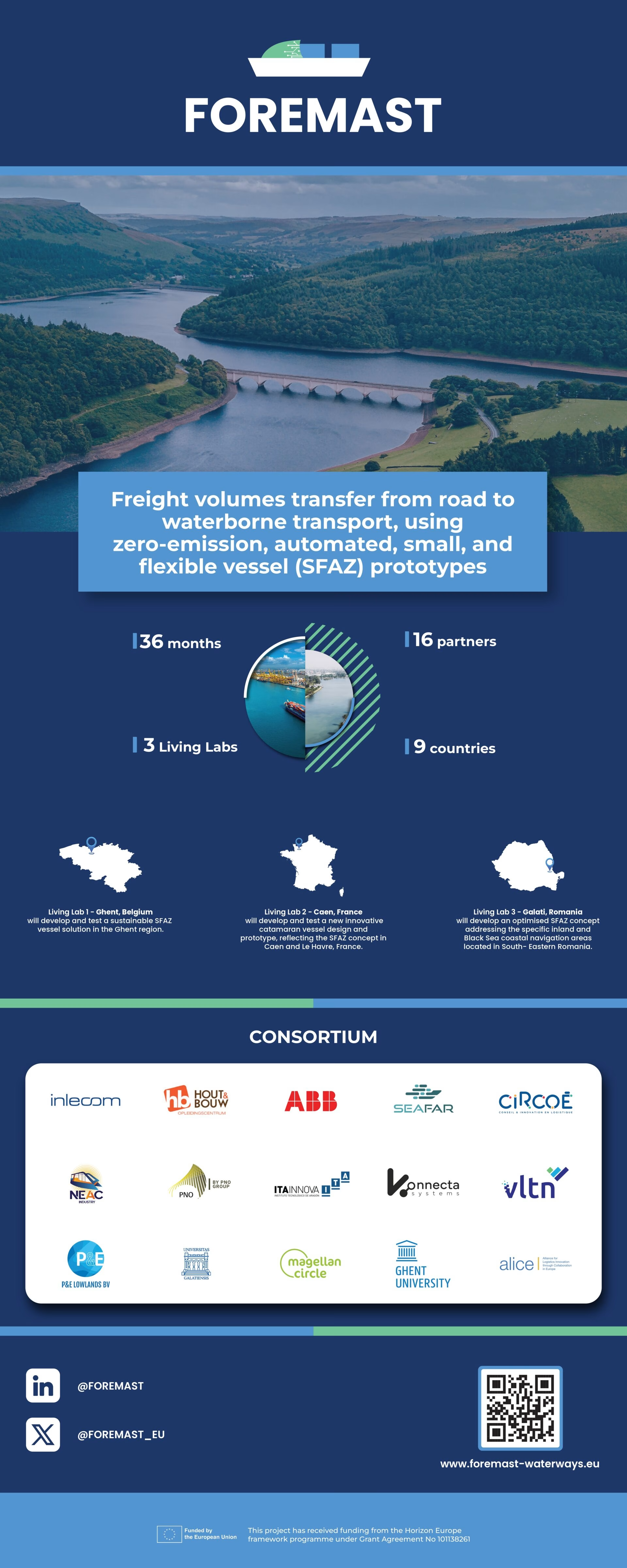
FOREMAST validates its solutions through three Living Labs representing different operational environments.
The Ghent Living Lab demonstrates a retrofitted autonomous vessel operating within urban logistics chains. Activities include:
The Caen Living Lab focuses on last-mile logistics using a newly developed SFAZ catamaran featuring:
The virtual Living Lab uses Digital Twin technologies to evaluate:
Validation activities assess operational efficiency, modal-shift potential, safety, economic viability, environmental performance and stakeholder acceptance.
ALICE supports the wider adoption and deployment of automated zero-emission inland waterway transport solutions.
Within FOREMAST, ALICE leads activities related to:
Opleidingscentrum Voor Hout en Bouw VZW (OHB), ABB Business Services Spolka z Ograniczona Odpowiedzialnoscia (ABBBS), ABB Oy (ABBFI), SEAFAR, NEAC Industry, Instituto Tecnologico de Aragon (ITA), Konnecta Systems IKE (KNT), P&E Lowlands B.V. (PEL), Universitatea Dunarea de Jos din Galati (UGAL), Magellan Circle – European Affairs Consultancy Ltd (MAG), Circle Connecting EU S.R.L. (CIC), European Inland Waterway Transport Platform (IWT), Universiteit Gent (UGent)
INLECOM, PNO, CIRCOE & VLTN



On 13 June, the AWARD Final Conference served as a ...
On 16 September 2025, ALICE participated in the first Port ...
Automation is reshaping European freight systems across roads, ports, terminals, ...
The workshop "Autonomous Inland Waterway Vessels: Market Ready or Are There ...
As Europe accelerates efforts towards zero-emission and digitally connected logistics ...
This project has received funding from the European Union's Horizon Europe research and innovation programme under grant agreement No. 101138261. Views and opinions expressed are however those of the author(s) only and do not necessarily reflect those of the European Union or the European Climate, Infrastructure and Environment Executive Agency (CINEA). Neither the European Union nor the granting authority can be held responsible for them.