

GOLIA

Governing, Optimising and Leveraging Innovations proActively for shaping future proof holistic mobility system through data-driven and social optimum-led model
GOLIA is a Horizon Europe project developing a new adaptive mobility governance model that combines data-driven decision-making, social well-being objectives, and inclusive policymaking to create fairer, more sustainable, and resilient urban mobility systems.
Project information
Ongoing
1 June 2025 - 31 May 2028 (36 months)
Horizon Europe Research and Innovation Action
101201950
Factsheet
ALICE Multifunctional Urban Space Community
ALICE Digital Urban Freight Community
- Mobility governance
- Social optimum
- Urban logistics
- Mobility as a Right (MaaR)
- Data-driven policymaking
Project overview
European cities face increasing challenges in balancing accessibility, sustainability, social inclusion, economic competitiveness, and quality of life. Traditional mobility planning often prioritises economic performance and transport efficiency, while wider societal impacts remain difficult to measure and manage.
GOLIA introduces a new governance approach based on a Social Optimum Mobility Index (SOMI), enabling cities to assess transport policies through indicators that reflect social well-being, accessibility, equity, health, environmental performance, and mobility freedom. By combining social sciences, transport research, digital technologies, artificial intelligence, and stakeholder engagement, GOLIA aims to support more adaptive and inclusive mobility systems.
The project brings together cities, research organisations, industry stakeholders, and associations to co-create and validate governance models capable of responding to societal changes, political transitions, and disruptive events while supporting the objectives of the European Green Deal and Sustainable Development Goals.
Objectives and expected outcomes
Objectives
GOLIA will:
Develop and validate the Social Optimum Mobility Index (SOMI) as a new framework for evaluating and guiding mobility policies.
Create an adaptive mobility governance model combining technological, legal, social, and governance innovations.
Improve data sharing and interoperability through the GO-X digital ecosystem.
Facilitate inclusive and participatory decision-making involving citizens, businesses, public authorities, and mobility stakeholders.
Support long-term resilience of mobility governance systems.
Enable replication and scaling through capacity building, peer learning, and policy guidance.
Expected results
A validated SOMI framework integrated into urban mobility planning processes.
Enhanced governance tools enabling inclusive and evidence-based decision-making.
Improved collaboration between public and private stakeholders in both passenger and freight transport.
New methodologies for stakeholder engagement and Mobility as a Right (MaaR).
Replication roadmaps for follower cities.
A Smart Mobility Governance Handbook supporting wider European uptake.
Policy recommendations supporting sustainable digital and green transitions.
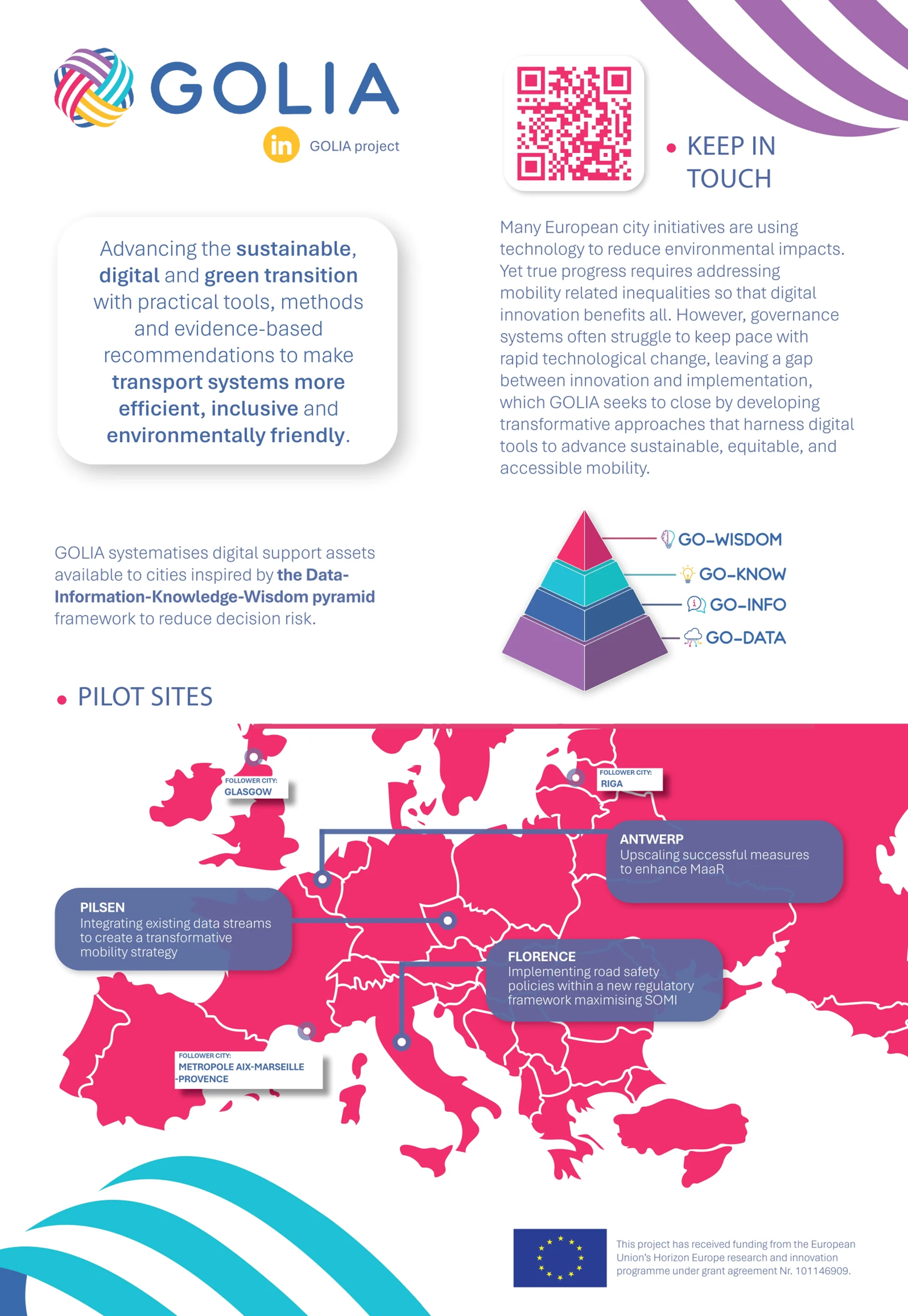
Demonstrations, pilots and validation
Living labs
Florence (Italy)
The Florence Living Lab focuses on improving urban logistics, active mobility, accessibility, and the flexible use of urban space. Activities include mobility hubs, logistics micro-hubs, parcel lockers, stakeholder engagement, and testing policies related to city-centre access and traffic management.
Antwerp (Belgium)
The Antwerp Living Lab focuses on increasing the adoption of active, shared, and multimodal mobility. The city will test approaches to scale up multimodal route-planning solutions through participatory design processes and serious gaming methodologies.
Plzeň (Czech Republic)
The Plzeň Living Lab focuses on reducing car dependency and supporting mobility transition planning. The city will test inclusive policymaking methods and strengthen cooperation between mobility planning and Integrated Territorial Investment frameworks.
Follower cities
The project will support knowledge transfer and replication activities in:
01 Marseille-Provence (France)
02 Glasgow (United Kingdom)
03 Riga (Latvia)
These cities will participate in study visits, peer-learning activities, stakeholder engagement exercises, and the development of tailored replication roadmaps.
Innovative solutions
The project develops a suite of interconnected digital governance tools known as the GO-X modules:
GO-DATA
A knowledge base and data space supporting the integration, management, monitoring, and interoperability of city mobility datasets and digital assets.
GO-INFO
Visualisation and consultation services including mobility dashboards, public feedback tools, and stakeholder engagement surveys.
GO-KNOW
A decision-support dashboard helping cities identify suitable digital tools, policies, and mobility solutions for specific governance challenges.
GO-WISDOM
An advanced decision-support platform integrating SOMI calculations, agent-based modelling, AI-supported forecasting, and social sentiment analysis to assess policy impacts and support collaborative mobility planning.
Social Optimum Mobility Index (SOMI)
The project's flagship innovation is the SOMI framework, which measures mobility performance across dimensions such as:
The index enables dynamic, place-based and time-dependent assessment of mobility systems to support more balanced policy decisions.
ALICE's role
ALICE contributes its expertise in logistics innovation and public-private collaboration throughout the project.
Key contributions include:
Setting the scene
- Supporting the identification of freight mobility needs within the ecosystem analysis and user attitude assessment activities.
- Contributing logistics perspectives to stakeholder engagement and mobility governance discussions.
Public-private collaboration and governance
- Leading Task 4.1 on developing effective mobility governance models through public-private collaboration.
- Supporting the integration of freight and passenger mobility planning.
- Contributing to sustainable business models for the GO-X modules.
Roadmaps and transferability
- Supporting the development of governance recommendations and replication approaches for European cities.
- Contributing to the Smart Mobility Governance Handbook.
Building and empowering the GOLIA community
- Participating in the Impact Creation Board (ICB).
- Supporting communication, dissemination, training, stakeholder engagement, and exploitation activities.
- Connecting GOLIA with other European initiatives, networks, and projects.
Related policy activities
- EGUM
Related project contributions
- EGUM Report “City Access for Businesses: Challenges and Best Practices for Urban Freight Transport”
- EGUM Report “Urban Nodes: Cooperation between Cities and Stakeholders of their Functional Urban Area (FUA)”
- POLIS-ALICE Joint Guide for Advancing Together Towards Zero-Emission Urban Logistics by 2030
Project resources
- Project website: https://www.golia-project.eu/
- LinkedIn: GOLIA on LinkedIn
Consortium members
With 21 partners representing cities, research organisations, industry stakeholders, and associations, GOLIA builds a comprehensive platform for reshaping urban mobility through innovation, collaboration, and social inclusion.
Consortium partners
BAX Innovation Consulting SL, Fundación Transporte ETS, Panteia BV, MuConsult BV, Centre for Research and Technology Hellas (CERTH), Digital Hub Management GmbH, INLECOM Innovation AS, Mpact, TTS Italia, IDIT - Institut du Droit International des Transports, SINTEF AS, EUROCITIES AISBL, UKEP Plzeň, Comune di Firenze, City of Antwerp, SUPSI - University of Applied Sciences and Arts of Southern Switzerland.
ALICE members in the consortium
ALICE, POLIS, UITP, European Parking Association (EPA), PAVE Europe, CERTH, SINTEF, FIT and INLECOM.



Related news
Related events
EU funding
This project has received funding from the European Union's Horizon Europe Research and Innovation Programme under Grant Agreement No. 101201950. Views and opinions expressed are however those of the author(s) only and do not necessarily reflect those of the European Union or the European Climate, Infrastructure and Environment Executive Agency (CINEA). Neither the European Union nor the granting authority can be held responsible for them.