
Understanding complexity and anticipating market trends: Insights from the ALICE & Contract Logistics Observatory Webinar
On 3 July 2025, ALICE and the Contract Logistics Observatory ...


IKIGAI is a Horizon Europe innovation project accelerating the deployment of the Physical Internet (PI) by 2040 and supporting the transition towards decarbonised freight transport and logistics by 2050 through scalable, collaborative and standardised logistics innovations.
Ongoing
July 2025 - December 2028 (42 months)
Horizon Europe Innovation Action
HORIZON-CL5-2024-D6-01
101202912
ALICE Intralogistics Community
Inspired by the Japanese concept of ikigai ("a reason for being"), IKIGAI seeks to transform European freight transport through the implementation of the Physical Internet paradigm. The project promotes collaborative, interconnected and standardised logistics networks capable of delivering both environmental and economic benefits.
To achieve this vision, IKIGAI supports the development and scale-up of innovative logistics solutions that improve interoperability, facilitate data sharing, increase asset utilisation, enable emissions transparency and support the transition towards zero-emission freight transport.
The project combines technological innovation, operational change, governance models and stakeholder engagement to address barriers that currently prevent logistics innovations from being widely adopted across Europe. Through real-life demonstrations, standards development and consensus building, IKIGAI aims to accelerate the transition towards affordable, scalable and collaborative logistics systems.
Objectives
IKIGAI aims to:
Pilot five Physical Internet Logistics Innovations (LIs) addressing key scalability barriers across European logistics networks.
Develop the PI Norm, a family of standardised operational procedures supporting Physical Internet adoption.
Create a practical roadmap for implementing the twin transition of digitalisation and decarbonisation in freight transport.
Establish governance mechanisms that enable large-scale collaboration across logistics ecosystems.
Assess innovation readiness, scalability and adoption potential through dedicated evaluation frameworks.
Build consensus among public and private stakeholders on the future development of Physical Internet-enabled logistics systems.
Expected results
Key project outcomes include:
Five validated Logistics Innovations progressing towards operational deployment.
The first PI Norm supporting interoperability, collaboration and standardisation.
A PI Coalition bringing together industry, logistics operators, policymakers and research organisations.
New business and operating models supporting collaborative logistics.
Improved emissions monitoring, reporting and transparency.
Increased intermodal transport utilisation and shared resource use.
Practical pathways toward widespread Physical Internet adoption by 2040.
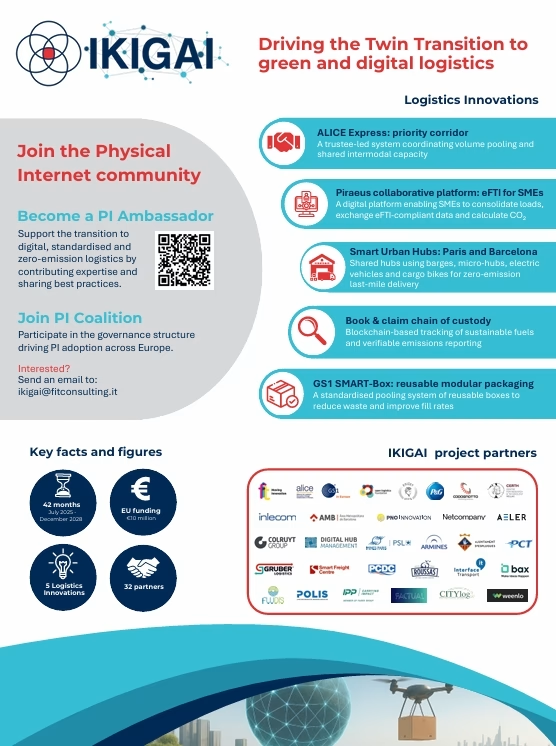
IKIGAI demonstrates five complementary Logistics Innovations through real-life pilots across Europe.
The five Logistics Innovations include:
ALICE Express: The pilot develops collaborative matchmaking, volume pooling and data-sharing services to improve intermodal and synchromodal freight operations while reducing emissions.
Collaborative Matchmaking Platform at Piraeus Free Zone (Greece): This pilot validates collaborative logistics services including load optimisation, cargo bundling, eFTI connectivity and volume pooling to improve operational efficiency and sustainability.
Smart and Synchromodal Urban Hubs (France and Spain): Pilots in Paris and Esplugues de Llobregat test synchronised multimodal urban logistics operations using road, waterborne and cargo-bike transport supported by digital coordination and smart contracts.
GRUBER Book & Claim: The pilot develops and validates a blockchain-supported chain-of-custody system for fuel and emissions data, improving transparency and reliability of freight emissions reporting.
GS1 SMART-Box Pooling Governance: Demonstrations in Belgium and France evaluate reusable standardised modular packaging systems and governance models for large-scale adoption.
IKIGAI develops a portfolio of innovations supporting the Physical Internet transition:
Physical Internet Logistics Innovations
PI Norm
A new family of standardised operational procedures covering logistics nodes, logistics networks, systems of logistics networks, governance and decarbonisation processes.
Twin Transition Genome
A future roadmap integrating the Physical Internet and Zero Emissions Logistics roadmaps to define realistic pathways towards 2040 and 2050 objectives.
PI Coalition and PI Observatory
New governance and stakeholder engagement structures supporting broad adoption, knowledge sharing and scaling of Physical Internet innovations.
ALICE plays a strategic role in IKIGAI as both innovation facilitator and ecosystem orchestrator.
Through IKIGAI, ALICE strengthens its mission to accelerate innovation, collaboration and decarbonisation across European logistics networks.
The IKIGAI consortium brings together 33 organisations from 13 European countries, representing logistics service providers, shippers, technology providers, research organisations, local authorities, innovation networks and standardisation bodies.
FIT Consulting SRL (Italy)
FIT Consulting (IT), BAX, Colruyt, P&G, CODOGNOTTO, GRUBER, ICCS, CERTH, AELER, PNO, INLECOM, FACTUAL, Smart Freight Centre, Digital Hub Management.














Open Logistics Foundation (OLF), ARMINES, MINES Paris, IPP GmbH (IPP), Netcompany-Intrasoft (NCI), CityLogin Iberica SL (CityLogin), FLUDIS, Àrea Metropolitana de Barcelona (AMB), Ajuntament d'Esplugues de Llobregat (ESPLUGUES), Piraeus Container Depot SA (PCDC), Piraeus Container Terminal SA (PCT), and ROUSSAS Anonymi Etaireia (ROUSSAS).
On 3 July 2025, ALICE and the Contract Logistics Observatory ...
Insights from Professor Alan McKinnon’s keynote speech at the IKIGAI ...
ALICE enables the IKIGAI project in its call for PI Ambassadors, a unique opportunity ...
ALICE has submitted its official response to the European Commission’s ...
This webinar brings together ALICE and the Japan Physical Internet ...

The transport, logistics and supply chain landscape is undergoing ...

IKIGAI has received funding from the European Union's Horizon Europe research and innovation programme under Grant Agreement No. 101202912. Views and opinions expressed are however those of the author(s) only and do not necessarily reflect those of the European Union or the European Climate, Infrastructure and Environment Executive Agency (CINEA). Neither the European Union nor the granting authority can be held responsible for them.