
Bridging the gap: How ZEFES project and Alternative Fuel Infrastructure Facility (AFIF) supports advancing zero-emission freight transport
The lack of charging and hydrogen refuelling infrastructure, as well as the ...



MACBETH is accelerating the electrification of long-haul road freight by developing, demonstrating, and validating user-centric megawatt charging hubs for battery electric trucks across Europe.
Ongoing
February 2025 - January 2029 (48 months)
Horizon Europe Innovation Action
101192466
ALICE Electrification Community
The decarbonisation of long-haul freight transport requires large-scale deployment of battery Battery-eElectric Ttrucks and the charging infrastructure needed to support them. While significant technological progress has been achieved, challenges related to deployment costs, user acceptance, interoperability, grid integration, operational efficiency, and business viability still hinder widespread adoption.
MACBETH addresses these barriers by developing and demonstrating multipoint Megawatt Charging System (MCS) hubs designed specifically for heavy-duty electric trucks. Through pilot sites in the Nordic Sweden and Benelux Belgiumregions, the project will validate innovative charging solutions, advanced digital tools, and user-centric hub concepts that support rapid deployment across Europe's TEN-T transport corridors, logistics terminals, and depots.
By combining technological innovation, stakeholder engagement, business model development, and real-world demonstrations, MACBETH aims to accelerate the transition towards zero-emission road freight while contributing to the objectives of the Paris Agreement, the European Green Deal, and Fit for 55 package of 90% emissions reduction by 2040.
Objectives
MACBETH will:
Establish a scalable framework for interoperable multipoint MCS, facilitating the integration of high-power charging solutions (charger towards vehicle).
Formulate advanced grid management strategies to minimise the impact of MCS deployment on the electrical grid while enhancing the user experience (charger towards grid).
Effectively integrate large-scale, multipoint MCS hubs along significant TEN-T corridors to serve a spectrum of vehicle types, from light-duty (passenger) vehicles (LDVs) to HDV trucks.
Create digital tools supporting charging demand forecasting, site selection, grid optimisation, and business case assessment.
Evaluate business models, scalability, environmental benefits, and system impacts to support large-scale deployment.
Deliver recommendations and deployment guidance for future roll-out of charging infrastructure and large-scale implementation.
Expected results
Two operational megawatt charging hubs equipped with both MCS and CCS connectors.
Technology Readiness Level (TRL) 8 system-level MCS hub concept.
Interactive charging demand and site selection tools for TEN-T corridors.
Business Case Assessment Tool for MCS hub deployment.
Advanced interoperable MCS charging technologies and automated charging solutions.
Best-practice guidance for charging hub design and operation.
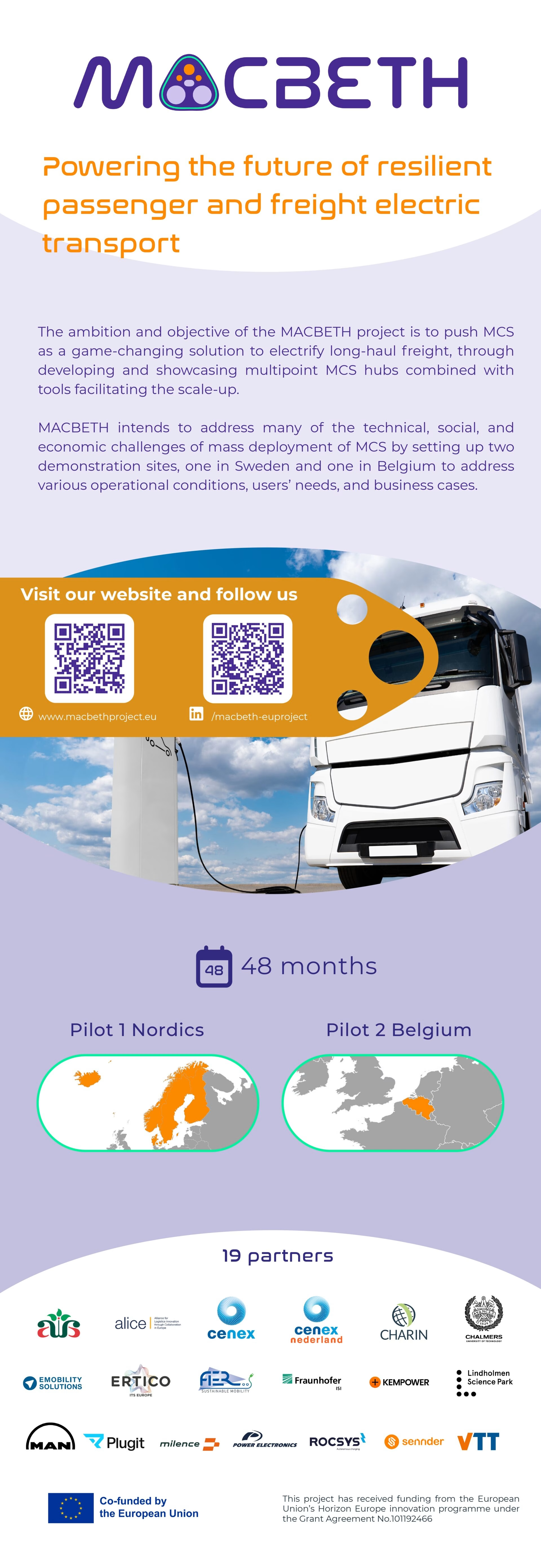
MACBETH will validate its solutions through two demonstration sites located in:
Nordic region (Sweden)
Benelux region (Belgium)
These pilot sites were selected to represent different geographic conditions, regulatory environments, business contexts, and operational scenarios.
The demonstrations will include the:
Deployment of multipoint megawatt charging hubs of 4 MW total peak power.
Testing of interoperable MCS charging technologies.
Integration of digital energy and charging management tools.
Validation of automated charging solutions.
Assessment of user experience, reliability, operational performance, and business viability.
Collection of real-world operational data from logistics operators and charging providers.
During the operational phase, logistics providers and fleet operators will use the charging infrastructure and contribute data for evaluating charging performance, scalability, and user acceptance.
ALICE plays a key role in connecting research, industry, policymakers, logistics operators, infrastructure providers, and technology developers.
MACBETH aligns strongly with ALICE's ambition to accelerate the transition towards zero-emission freight and logistics. Through its expertise in innovation ecosystems, stakeholder engagement, business model development, and supply chain sustainability, ALICE helps ensure that project results respond to real operational needs and can be effectively scaled across Europe.
VTT Technical Research Centre of Finland (Finland)
VTT Technical Research Centre of Finland, ALICE – Alliance for Logistics Innovation through Collaboration in Europe, Cenex Nederland, FIER, Kempower, Rocsys, Plugit Sweden AB, Milence, Power Electronics España SL, CharIN e.V., Alex Andersen Ølund A/S, EMDS Logistic Consulting Ltd, Cenex UK, MAN Truck & Bus SE, Fraunhofer-Gesellschaft, Lindholmen Science Park.




The lack of charging and hydrogen refuelling infrastructure, as well as the ...
The decarbonisation of heavy-duty transport is gaining momentum across Europe, ...
The AEVETO Cluster (Advanced Electric Vehicles for Efficient and Economic ...
On 5 May 2025, ALICE, in partnership with Smart Freight ...

The European Commission's review of the Alternative Fuels Infrastructure Regulation ...
The European Automotive Partnership preparation has reached an important milestone ...
The rollout of truck charging infrastructure along the TEN-T network ...
The MACBETH project invites you to a high-impact stakeholder workshop ...

This project has received funding from the European Union's Horizon Europe Research and Innovation Programme under Grant Agreement No. 101192466. Views and opinions expressed are however those of the author(s) only and do not necessarily reflect those of the European Union or the European Climate, Infrastructure and Environment Executive Agency (CINEA). Neither the European Union nor the granting authority can be held responsible for them.