TRA 2024 – ALICE looks forward to welcoming you at our Logistics Innovation Village
ALICE is one of the co-organizers of the next Transport ...


MODI is a Horizon Europe Innovation Action accelerating the deployment of SAE Level 4 Connected, Cooperative and Automated Mobility (CCAM) solutions for freight transport by demonstrating automated logistics operations along the Rotterdam-Oslo transport corridor.
Ongoing
Completed (project period: October 2022 – September 2026, 42 months)
Horizon Europe Innovation Action
101076810
The introduction of Connected, Cooperative and Automated Mobility (CCAM) technologies has the potential to transform European logistics by improving safety, efficiency, reliability and sustainability. However, significant barriers remain, including technological maturity, infrastructure readiness, regulatory differences between countries, and societal acceptance.
MODI addressed these challenges through large-scale demonstrations of highly automated freight vehicles operating across the European motorway corridor between Rotterdam (Netherlands) and Oslo (Norway), crossing multiple national borders and integrating logistics operations in ports, terminals and public-road environments.
The project brought together logistics operators, vehicle manufacturers, infrastructure managers, research organisations, authorities and industry associations to identify barriers, validate solutions and accelerate the safe deployment of SAE Level 4 automated freight transport across Europe.
Objectives
Demonstrate SAE Level 4 automated freight transport in real logistics operations.
Identify and overcome technological, infrastructure and regulatory barriers affecting cross-border automated transport.
Develop business models supporting the large-scale deployment of automated freight vehicles.
Define recommendations for infrastructure adaptation, standardisation and regulatory harmonisation.
Validate coordinated CCAM services enabling efficient interactions between vehicles, logistics operators and road authorities.
Assess environmental, economic, safety and societal impacts of automated freight transport.
Expected results
Demonstrated automated logistics operations across public roads, terminals and ports.
Coordinated CCAM interfaces enabling standardised vehicle-to-infrastructure interaction.
Recommendations for harmonised regulations and standards across European transport corridors.
Business model templates supporting the commercial deployment of automated logistics services.
Impact assessments covering environmental performance, safety, operational efficiency and socio-economic outcomes.
A comprehensive Book of Recommendations supporting future deployment of automated freight transport.
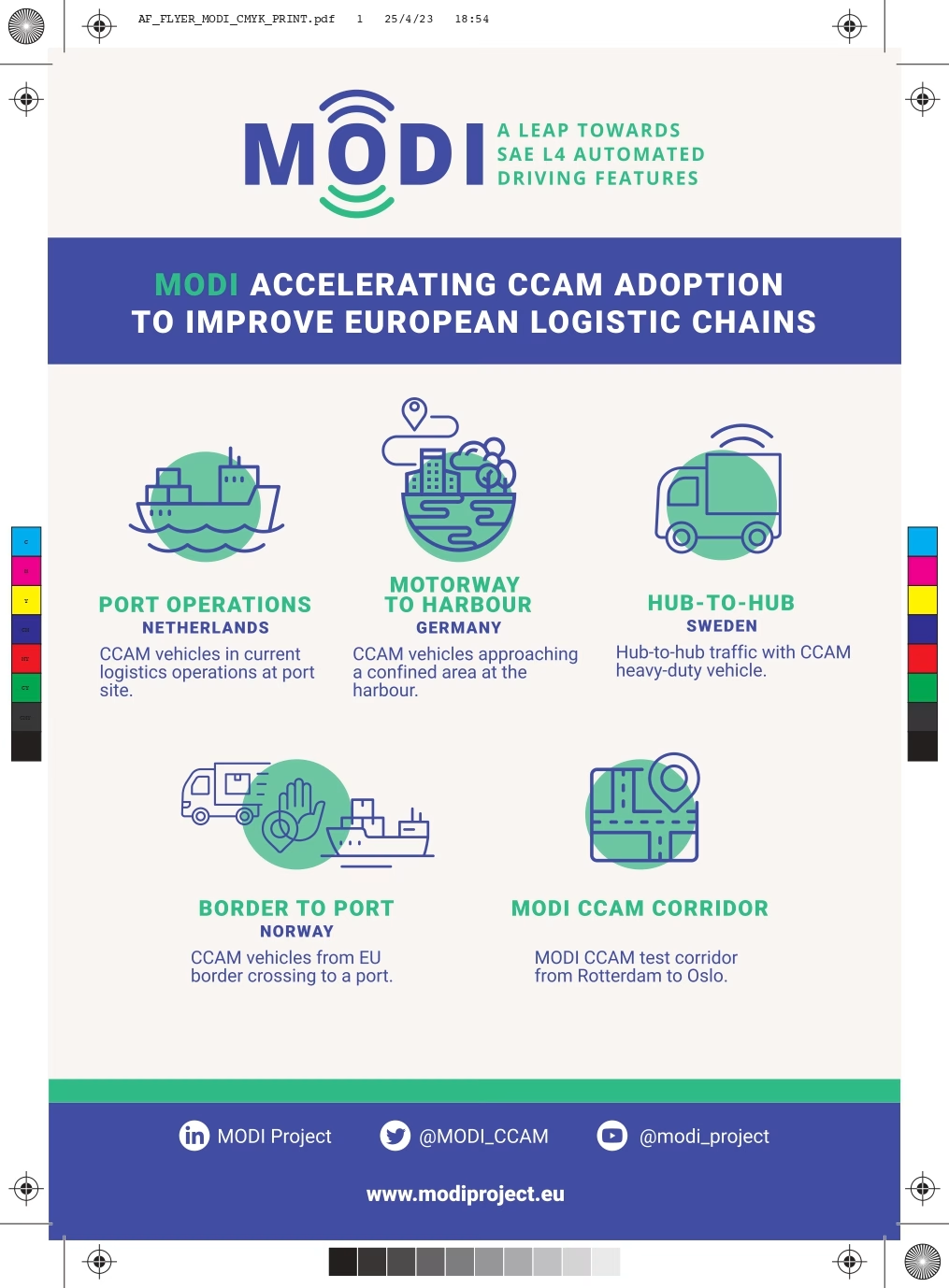
MODI implemented five interconnected use cases covering different segments of the logistics chain.
Use case 1
Netherlands
Use case 2
Germany
Use case 3
Sweden
Demonstration of automated logistics chains including:
Use case 4
Norway
Use case 5
Rotterdam-Oslo CCAM corridor
The project assessed CCAM deployment across the full Rotterdam-Oslo transport corridor. Real-life data collection campaigns identified critical road sections, infrastructure requirements and operational challenges affecting Level 4 automated freight transport.
Enabling co-existence of human and automated trucks in ports and terminals
This solution focuses on the safe and efficient integration of autonomous trucks into busy port and terminal environments. It develops operational concepts, procedures and digital coordination mechanisms that allow automated and conventional vehicles to share infrastructure, improving efficiency while maintaining high safety standards.
Automated trucks motorway-to-harbour transition
This innovation enables autonomous trucks to seamlessly move between motorway networks and complex harbour environments. It addresses operational challenges related to navigation, connectivity, traffic management and control during the transition between long-haul road transport and logistics hubs.
Hub-to-hub freight automation
This solution demonstrates automated freight transport between logistics hubs, enabling autonomous vehicles to carry goods over predefined routes with minimal human intervention. The approach aims to increase transport efficiency, reduce operating costs and improve the reliability of freight movements.
Finding the true value of road automation
This innovation develops methodologies and assessment frameworks to quantify the economic, environmental, operational and societal benefits of road automation. It provides evidence-based insights to support investment decisions, policy development and large-scale deployment of autonomous freight transport solutions.
Automated loading and unloading of autonomous trucks
This solution automates the handling processes associated with freight transport, enabling autonomous trucks to load and unload cargo with limited human involvement. By integrating automated warehouse and vehicle operations, it reduces turnaround times and improves efficiency across logistics chains.
Battery electric vehicle automated charging
This innovation combines automation and zero-emission transport by enabling autonomous charging of battery electric trucks. Automated charging systems reduce operational downtime, support continuous vehicle operation and facilitate the large-scale deployment of electric autonomous freight transport.
The consortium comprises 29 partners, including several ALICE members representing industry, research, infrastructure, logistics and technology organisations.
ITS Norway (Norway)
CLOSER, DFDS, Einride, GRUBER Logistics, ITS Norway, Rijkswaterstaat (RWS), SINTEF, TNO, TØI – Institute of Transport Economics, Trafikverket and Volvo.










DAF, Freee Valley, Techvolution, Maersk, ENIDE, Innmove by Railgrup, ESC Logistics Learning Innovation, CLEPA, Port of Roenne, APM Terminals, New Mobility Services Hamburg, Statens vegvesen, Rijkswaterstaat, Ministry of Infrastructure and Water Management, Hamburg, Viken Fylkeskommune, Kartverket, Eindhoven University of Technology (TU/e), University of Applied Sciences, AstaZero, Bast, Moss Havn, Port of Hamburg, and Vejdirektoratet.
ALICE is one of the co-organizers of the next Transport ...
On 13 June, the AWARD Final Conference served as a ...
The High-Level Dialogue on Connected and Automated Driving took place ...
On 3 December 2024, ALICE participated in the third Co-Creation ...

On 13th of February 2026, from 13:00 to 14:00 CET, ...
About the Webinar The MODI Logistics Task Force continues its ...
We are pleased to invite you to an upcoming webinar ...
The transport, logistics and supply chain landscape is undergoing ...

MODI received funding from the European Union's Horizon Europe research and innovation programme under Grant Agreement No. 101076810. Views and opinions expressed are however those of the author(s) only and do not necessarily reflect those of the European Union or the European Climate, Infrastructure and Environment Executive Agency (CINEA). Neither the European Union nor the granting authority can be held responsible for them.