ALICE welcomes Elvina Nowak and Tomas Ambra to the ALICE secretariat team
ALICE welcomed Elvina Nowak and Tomas Ambra as part of ...



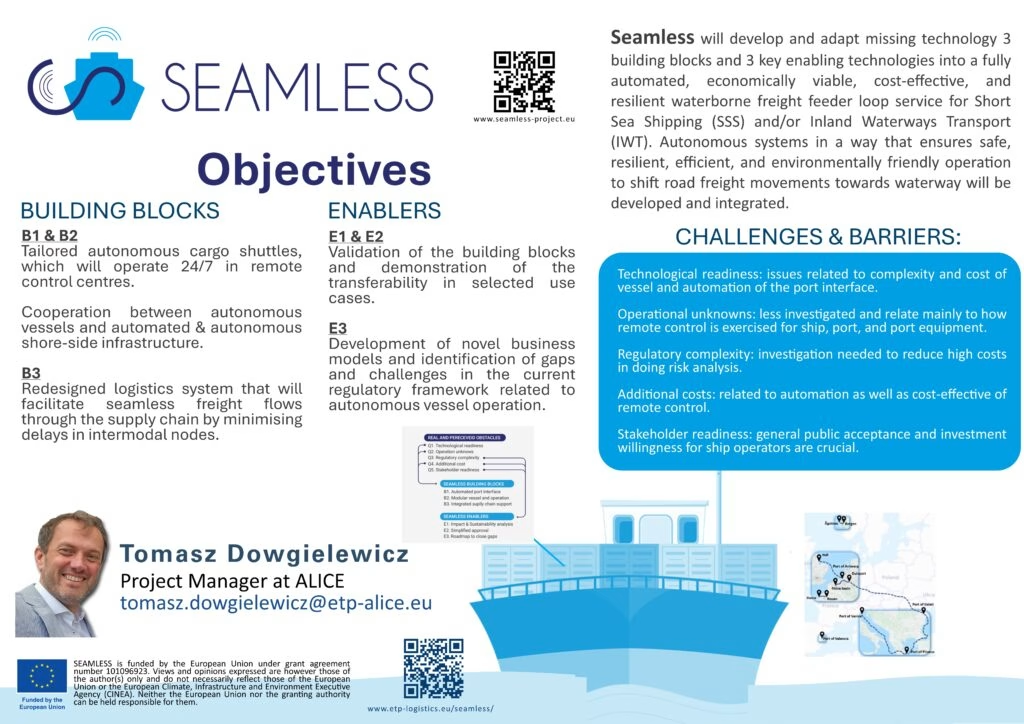
SEAMLESS is developing a fully automated, economically viable and resilient waterborne freight feeder service for Short Sea Shipping (SSS) and Inland Waterways Transport (IWT), combining autonomous vessels, automated port infrastructure and digital logistics management to enable seamless, zero-emission freight flows across Europe.
Ongoing
January 2023 - December 2026 (48 months)
Horizon Europe Research and Innovation Action (RIA)
101096923
Digital Transport & Logistics Forum (DTLF) / eFTI community
Ports & Logistics community
Automation and Autonomous Logistics initiatives
Potentially the emerging DAFNE / data sharing activities if ALICE wishes to show links to logistics digitalisation
European freight transport faces increasing challenges linked to congestion, environmental performance, supply chain resilience and administrative complexity. While waterways offer significant untapped capacity, barriers related to automation, interoperability, regulation and business viability continue to limit their wider adoption.
SEAMLESS addresses these challenges by developing a fully automated waterborne freight feeder loop service for short sea shipping and inland waterways transport. The project integrates autonomous cargo vessels, automated port infrastructure, remote operation centres and advanced digital logistics capabilities to create a safe, efficient and resilient transport system operating 24/7.
A key feature of the project is the creation of a digital "bird's-eye view" of logistics networks, enabling real-time optimisation, adaptive planning and seamless freight flows across transport modes. Through large-scale demonstrations and transferability analyses across Europe, SEAMLESS aims to accelerate modal shift from road to waterways while supporting European Green Deal and TEN-T objectives.
Objectives
SEAMLESS pursues five main objectives:
Improve the cost-effectiveness and safety of automated and autonomous port-side infrastructure.
Simplify deployment requirements and reduce investment risks for autonomous waterborne services.
Develop sustainable and scalable business models for inland waterways and short sea shipping.
Integrate autonomous feeder services within Europe's digital logistics ecosystem.
Support regulatory evolution through recommendations, roadmaps and guidance for policymakers.
Expected results
Autonomous cargo shuttles operating in feeder-loop services.
Automated mooring and cargo-handling solutions.
Remote Operation Centres (ROCs) supporting low-attention vessel supervision.
ModalNET logistics network digital twin.
Digitalised administrative processes and interoperable information exchange.
Improved risk-based safety assessment methodologies.
New sustainability-driven business models.
Guidance and policy recommendations supporting market deployment.
SEAMLESS validates its solutions through full-scale demonstrations and transferability assessments across multiple European regions.
Demonstration activities
The project combines physical and digital assets to demonstrate:
Autonomous navigation in short sea shipping and inland waterway environments.
Automated docking and mooring operations.
Autonomous cargo handling systems.
Remote vessel monitoring and management through ROCs.
Digital logistics orchestration and real-time optimisation through ModalNET.
Validation approach
The project evaluates technical, economic, environmental and societal performance through:
Full-scale demonstration cases.
Transferability analyses covering at least seven deployment scenarios.
Sustainability assessments.
Business case evaluations.
Regulatory and operational impact analyses.
Stakeholder engagement
SEAMLESS actively engages ports, logistics operators, technology providers, policymakers, waterway authorities and shippers to ensure practical adoption and replication of project results.
ModalNET: Logistics network digital twin
A real-time digital twin providing end-to-end visibility across logistics networks. The solution supports adaptive logistics planning, synchromodal transport management, disruption response, digital document exchange and secure data sharing between supply chain stakeholders.
Zero-emission autonomous vessels
A portfolio of sustainable vessel technologies and deployment concepts aimed at enabling zero-emission inland waterway transport. The solution explores battery-electric propulsion, fuel cell systems, alternative fuels and the implementation of zero-emission feeder services.
DockNLoad: Automated port interface
An integrated port automation solution that streamlines interactions between vessels and terminals. It combines autonomous mooring, automated cargo handling, automated stowage planning and intelligent port management to improve efficiency and reduce operational costs.
Autonomous vessel and operations concepts
A set of advanced technologies and operational concepts supporting safe and reliable autonomous navigation. Innovations include modular vessel designs, risk-based safety assessment methods, COLREG-compliant navigation systems, fault-tolerant control architectures and low-attention remote operation centres.
ALICE leads dissemination and logistics-sector engagement activities within SEAMLESS.
National Technical University of Athens (NTUA), Greece
Delft University of Technology (TU Delft), Duisburger Hafen AG (duisport), Institute of Transport International Ltd (IDIT), SINTEF Ocean AS, Fundación Valenciaport, PNO Innovation, and Development Centre for Ship Technology and Transport Systems (DST).






Bergen Havn AS, TIC 4.0, Zulu Associates, CiaoTech S.r.l., Innovation Engineering S.r.l., Norwegian University of Science and Technology, MacGregor Finland Oy, MacGregor Sweden AB, Institute for Shipping Economics and Logistics, Institut de Recherche Technologique SystemX, Entwicklungszentrum für Schiffstechnik und Transportsysteme e.V., Voies Navigables de France, ASKO Maritime AS, ALICE, Inland Shipping SRL, Haven van Antwerpen-Brugge, Antwerp Maritime Information Systems, University of Belgrade Faculty of Transport and Traffic Engineering, Kongsberg Maritime AS, Kongsberg Maritime Finland Oy, Bureau Veritas Marine & Offshore, Awake.AI Oy, Piraeus Container Terminal S.A., and MacGregor Norway AS.
ALICE welcomed Elvina Nowak and Tomas Ambra as part of ...
ALICE is one of the co-organizers of the next Transport ...
As part of the journey towards more efficient logistics processes, ...
On 5 June 2025, ALICE hosted the introductory webinar of ...

As Europe accelerates efforts towards zero-emission and digitally connected logistics ...
This webinar will explore the cybersecurity challenges and trust requirements ...
Remote operation of vessels is often presented as a technological ...
The webinar will explore the integration of rule-awareness, semantics and ...

SEAMLESS is funded by the European Union under Grant Agreement No. 101096923. Views and opinions expressed are however those of the author(s) only and do not necessarily reflect those of the European Union or the European Climate, Infrastructure and Environment Executive Agency (CINEA). Neither the European Union nor the granting authority can be held responsible for them.