
TRA 2024 – ALICE looks forward to welcoming you at our Logistics Innovation Village
ALICE is one of the co-organizers of the next Transport ...


Accelerating the adoption of zero-emission heavy-duty vehicles for long-haul freight transport through advanced battery-electric and fuel-cell vehicle platforms, innovative charging and refuelling solutions, and real-world demonstrations across Europe.
Ongoing
January 2023 - December 2026
Horizon Europe Innovation Action
101095856
Road freight transport remains one of the most challenging sectors to decarbonise while maintaining efficient and reliable supply chains. Long-haul operators require zero-emission vehicles that can deliver sufficient range, payload capacity, operational flexibility and total cost competitiveness compared with conventional diesel trucks.
ZEFES aims to accelerate the large-scale deployment of zero-emission heavy-duty vehicles by developing and demonstrating flexible Battery Electric Vehicles (BEVs) and Fuel Cell Electric Vehicles (FCEVs) equipped with modular powertrains and supported by advanced charging and hydrogen refuelling solutions. The project brings together vehicle manufacturers, trailer manufacturers, logistics operators, infrastructure providers and research organisations to address technical, operational, infrastructure and business barriers.
ZEFES demonstrates nine different zero-emission vehicle concepts operating in real logistics environments across major European freight corridors. The demonstrations include Battery Electric Vehicles (BEVs), Fuel Cell Electric Vehicles (FCEVs) and Megawatt Charging Systems (MCS), validating technologies, operational models and digital tools needed to accelerate the deployment of zero-emission freight transport in Europe.
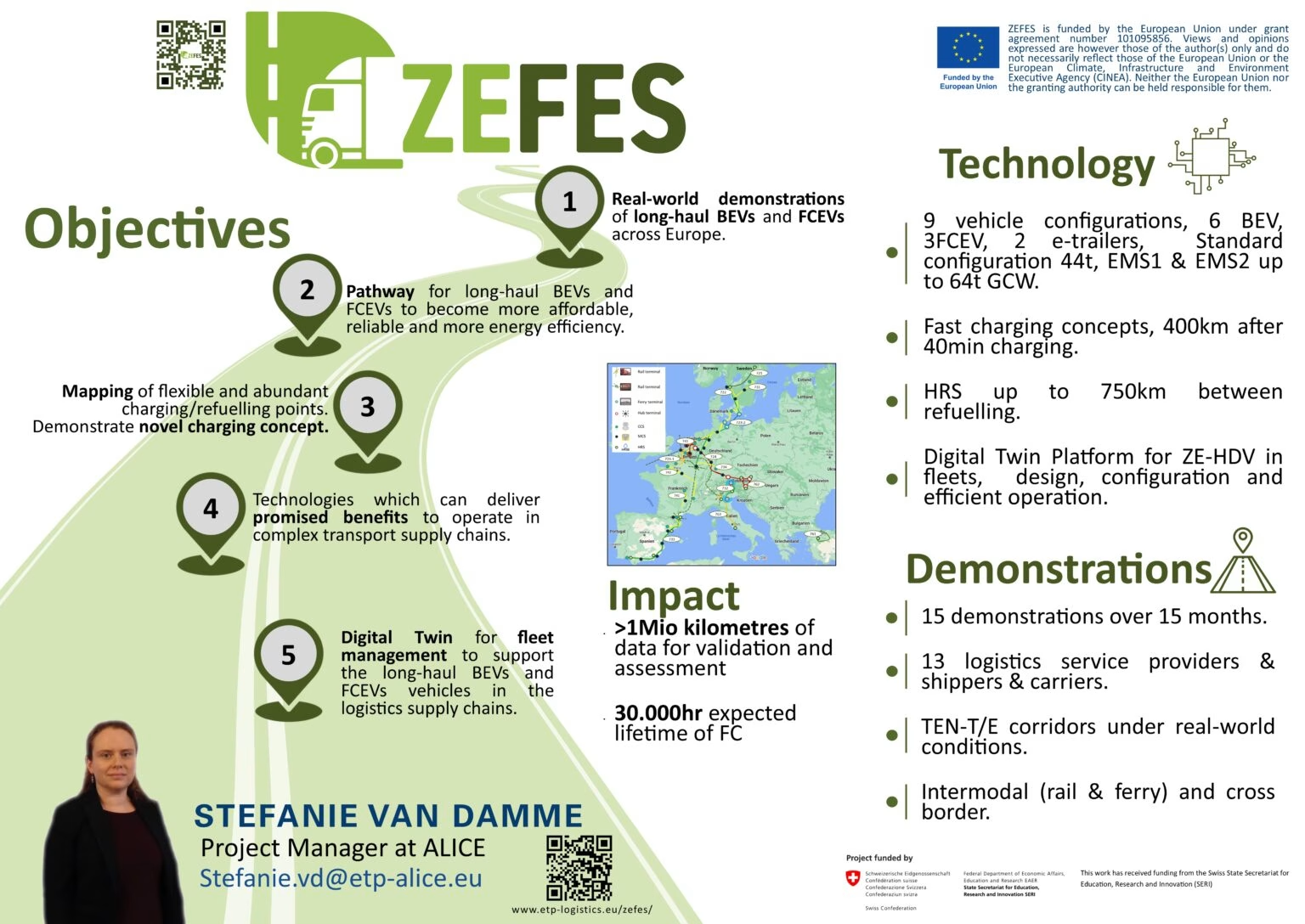
Objectives
Demonstrate long-haul BEV and FCEV operations in real logistics environments across Europe.
Improve the affordability, reliability and energy efficiency of zero-emission heavy-duty vehicles.
Enable longer driving ranges and reduced charging or refuelling times.
Develop modular vehicle architectures adaptable to different logistics missions and vehicle configurations.
Support deployment of charging and hydrogen refuelling infrastructure for long-haul freight.
Develop advanced fleet management and digital twin solutions to optimise vehicle operations.
Provide evidence and recommendations to support future policy, standards and market adoption.
Expected outcomes
Nine zero-emission heavy-duty vehicle concepts (6 BEVs and 3 FCEVs) demonstrated in daily freight operations across Europe.
Validation of long-haul operations for vehicles carrying loads above 40 tonnes under real operating conditions.
More than one million kilometres of real-world demonstration across European transport corridors.
Improved vehicle energy efficiency and operational performance.
New charging concepts and mapped charging and hydrogen refuelling networks.
Digital fleet management, mission planning and predictive maintenance tools.
Business models and total cost of ownership methodologies supporting investment decisions.
ZEFES will validate technologies and operational concepts through a comprehensive programme of demonstrations involving logistics operators, vehicle manufacturers and infrastructure providers.
Demonstration highlights
Nine vehicle concepts comprising six BEVs and three FCEVs.
Demonstration of two Megawatt Charging Systems (MCS) supporting long-haul electrification.
More than 1 million kilometres of operation in real logistics missions.
Demonstrations across major EU freight corridors.
Vehicle operation at high gross vehicle weights, including combinations up to 64 tonnes.
Validation of fast charging, megawatt charging and hydrogen refuelling solutions.
Demonstration of electrified trailers, battery trailers and distributed powertrain concepts.
Testing of digital twin and fleet management platforms alongside physical demonstrations.
Zero-emission vehicle platforms
Development and demonstration of modular Battery Electric Vehicles (BEVs) and Fuel Cell Electric Vehicles (FCEVs), including innovative truck-trailer combinations designed for long-haul freight transport.
Distributed powertrain concepts
Integration of electrified trailers, battery trailers and e-dollies to improve operational flexibility, enhance vehicle performance and support more efficient zero-emission freight operations.
Zero-emission vehicle buying decision tool
A decision-support tool helping fleet operators assess and select the most suitable zero-emission vehicle solutions based on operational requirements, infrastructure availability and business needs.
Reliable mission planning for electric trucks
A planning tool supporting the deployment of electric trucks by integrating route planning, charging opportunities and operational constraints into daily logistics operations.
Determining the right vehicle for the right duty
A fleet-deployment tool that matches vehicle characteristics with specific transport missions, helping operators optimise vehicle selection and utilisation.
Megawatt Charging Systems (MCS)
Development and demonstration of Megawatt Charging Systems (MCS) and advanced charging concepts to support the large-scale deployment of long-haul battery-electric freight transport.
ALICE participates in ZEFES because achieving zero-emission logistics requires close collaboration between technology developers, logistics operators, infrastructure providers and policymakers.
ZEFES directly supports ALICE's vision of enabling an affordable transition towards zero-emission logistics. The project addresses critical barriers that currently slow the uptake of zero-emission road freight solutions.
“The ZEFES project will support the transport and logistics ecosystem to address the interdependencies across sectors (energy, charging, vehicles and users) to accelerate the adoption of zero-emission road transport technologies in Europe.”
Fernando Liesa, Secretary General, ALICE
ALICE leads stakeholder engagement and logistics-user involvement across the project through:
Vrije Universiteit Brussel (VUB), Belgium
The project has 40 partners from all over Europe, representing the entire heavy-duty value chain.
Volvo, Scania, GRUBER LOGISTICS, Gebrüder Weiss, Procter & Gamble, Colruyt Group, Grupo Sesé, PTV and TNO.









Ford Otomotiv, Hyundai Motor Europe Technical Center, Renault Trucks, Kässbohrer, Van Eck Trailers, AIR Products, AVL, Sociedad Española de Carburos Metálicos, Hitachi Energy, Ricardo, ZF, Michelin, ABB, Plastic Omnium New Energies, Fraunhofer, HAN University of Applied Sciences, Applus+ IDIADA, Vrije Universiteit Brussel (VUB), CFL Multimodal, IRU, UIC, DPD, Primafrio, Uniresearch, Ricardo Prague, Ricardo GmbH and CV Systems.
ALICE is one of the co-organizers of the next Transport ...
On 30th January, the ZEFES project (Zero Emissions flexible vehicle ...
The ALICE Logistics Innovation Summit session, “Levers and challenges for ...
The lack of charging and hydrogen refuelling infrastructure, as well as the ...
Electrifying long-haul freight requires more than zero-emission vehicles: it also ...
The European Automotive Partnership preparation has reached an important milestone ...
DHL, in collaboration with Scania, has launched a solution aimed ...
The transport, logistics and supply chain landscape is undergoing ...

ZEFES has received funding from the European Union's Horizon Europe research and innovation programme under Grant Agreement No. 101095856. Views and opinions expressed are however those of the author(s) only and do not necessarily reflect those of the European Union or the European Climate, Infrastructure and Environment Executive Agency (CINEA). Neither the European Union nor the granting authority can be held responsible for them.