Official launch ALICE
The European Technology Platform on Logistics, ALICE, was officially launched ...


Developing and validating an interoperable framework for integrating smart inland waterway transport into multimodal logistics chains.
Ongoing
1 October 2026 to 30 September 2029, 36 months
Horizon Europe
101318845
ALICE IWT Community
ALICE Express
European inland waterway transport has considerable potential to support more sustainable and resilient freight movement. However, digital and physical solutions are frequently developed in isolation, making their integration into wider multimodal logistics chains difficult.
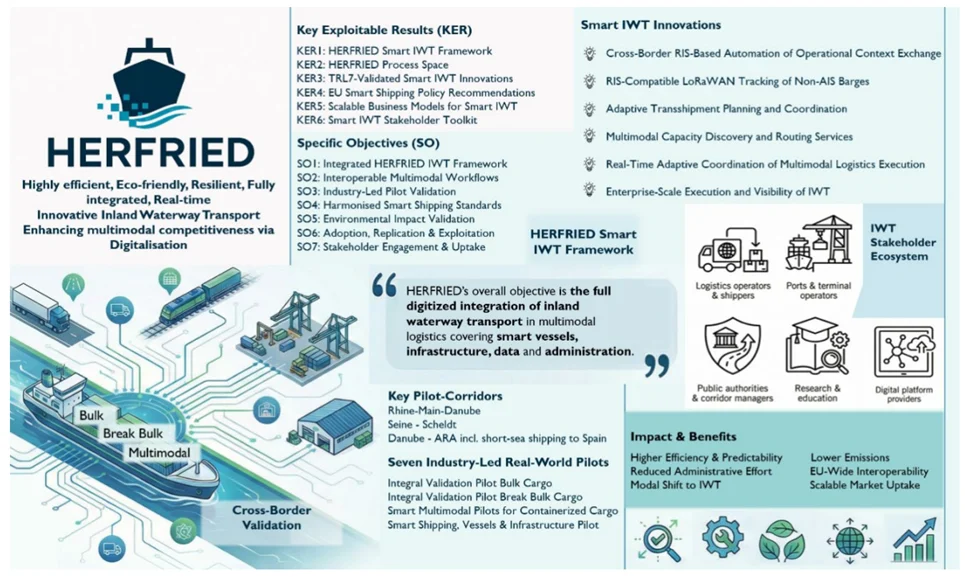
HERFRIED addresses this challenge by developing a first-of-a-kind interoperable framework for the seamless integration of smart inland waterway transport into multimodal supply chains. The framework will combine digital and physical solutions, support real-time coordination and enable innovations to connect with broader logistics systems and transport modes.
The project builds on existing partner platforms, previous research projects and ongoing innovation initiatives. Its solutions will be validated under real operational conditions through seven industry-led pilots covering bulk, break-bulk and multimodal cargo movements across European transport corridors.
By aligning operational requirements, stakeholder needs and evolving regulatory expectations, HERFRIED aims to improve the efficiency, reliability and competitiveness of inland waterway transport and support its increased use within European multimodal logistics chains.
Objectives
HERFRIED aims to:
Develop an interoperable smart inland waterway transport framework that integrates digital and physical innovations.
Connect inland waterway operations more effectively with multimodal logistics systems and other transport modes.
Identify and prioritise relevant innovations and use cases in collaboration with industry stakeholders.
Validate integrated solutions in real operational environments.
Establish consistent methods for assessing the social, economic and environmental effects of the pilots.
Develop business, policy and governance conditions that support the long-term adoption of smart inland waterway transport.
Produce recommendations supporting standardised and interoperable inland waterway operations.
Expected results
An enhanced interoperable framework for integrating inland waterway transport into multimodal logistics chains.
HERFRIED Process Space and interoperable data workflowsA supporting standardised inland waterway operations.
Cross-border validation of the HERFRIED framework through real-world cargo pilots.
A comprehensive KPI framework for evaluating social, economic and environmental impacts.
Policy recommendations supporting standardised smart inland waterway operations.
Innovative business models for integrated inland waterway transport.
Replicable pathways for introducing future digital innovations into the HERFRIED framework.
HERFRIED will help improve the operational efficiency, reliability and connectivity of inland waterway transport. By making smart inland waterway solutions easier to integrate with wider supply chains, the project supports modal shift, transport digitalisation and more sustainable European freight operations.
The framework is intended to be scalable and applicable across European inland waterway corridors. Its interoperable approach will also support the future onboarding of new technologies and services as market requirements, standards and regulatory expectations evolve.
HERFRIED will validate its Smart IWT Framework through seven industry-led pilots operating under real-world conditions. The pilots will cover bulk, break-bulk and multimodal container flows across several European basins and corridors, including:
The geographical areas include:
Rhine-Main-Danube
Seine-Scheldt
Amsterdam-Rotterdam-Antwerp
Connections with Spain, including the Port of Pasaia
The pilots will test predefined interoperable solutions and use cases co-designed with industry stakeholders. Validation will assess operational relevance, technical and business feasibility, scalability and potential for wider European application.
Stakeholder input will be gathered through desk research, interviews, surveys, workshops and direct engagement with shippers, logistics service providers, inland waterway operators, ports, terminals and public authorities. This process will help ensure that project solutions reflect practical operational requirements and policy needs.
HERFRIED smart IWT framework
The project will develop an interoperable framework integrating smart vessels, infrastructure, data, administration and logistics services. The framework will describe value propositions, stakeholder roles, business models, policy recommendations and governance mechanisms for adopting smart inland waterway innovations.
HERFRIED Process Space and interoperable data workflows Common data space
HERFRIED will develop a sector-wide common data space designed to support standardised information exchange and more coordinated inland waterway operations.
Integrated use cases
The project will identify, assess and demonstrate use cases for bulk cargo, break-bulk cargo and multimodal container operations. Use cases will be selected with industry stakeholders and refined according to operational and technical requirements.
KPI and impact-assessment framework
A harmonised KPI framework will support the assessment of the pilots’ social, economic and environmental effects. The framework will enable consistent pre-assessment and post-assessment and will address quantitative indicators alongside qualitative aspects that cannot be captured reliably through pilot data alone.
Business and adoption framework
HERFRIED will develop business models, exploitation pathways and policy recommendations to support the broader adoption of integrated smart inland waterway solutions.
ALICE participates in HERFRIED to ensure that the framework and its innovations respond to multimodal logistics requirements and can support long-term industry uptake.
ALICE leads the work package on innovative solutions, use cases and the HERFRIED smart inland waterway transport framework. Within this work, ALICE is responsible for developing the overall HERFRIED framework and leading stakeholder needs, barriers, requirements and enablers analysis.
HERFRIED brings together 17 organisations from Austria, Belgium, France, Germany, Hungary, the Netherlands and Poland. The consortium includes research organisations, technology providers, logistics and transport operators, industry associations, industry and public authorities. This combination is intended to connect technology development with operational needs and policy requirements.
FH OÖ Forschungs & Entwicklungs GmbH, Austria
imec, FHOOE, University of Antwerp, Transporeon, De Vlaamse Waterweg and AI Cargo Foundation.


The European Technology Platform on Logistics, ALICE, was officially launched ...
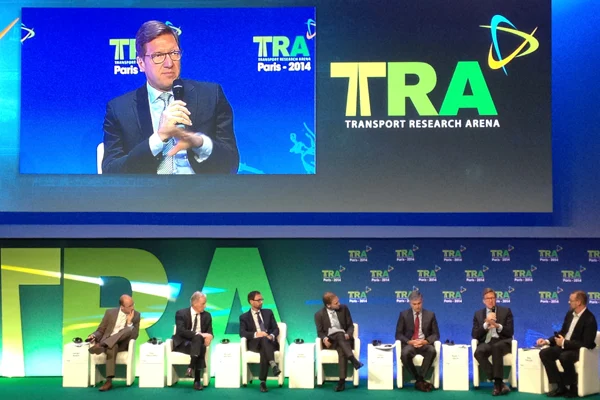
During the Transport Research Arena 2014 in Paris La Défense (14 ...
At Wednesday February 11 the first annual conference of ETP ...
ALICE liaises with running research and innovation projects and initiatives ...

Women in Logistics Circle: Connect, Learn and Grow Together Join ...

Electrifying long-haul freight requires more than zero-emission vehicles: it also ...

This webinar is part of Multifunctional Urban Space Community Urban ...
The European Commission's review of the Alternative Fuels Infrastructure Regulation ...
This project has received funding from the European Union’s Horizon Europe research and innovation programme under grant agreement No 101318845. Views and opinions expressed are however those of the author(s) only and do not necessarily reflect those of the European Union or the European Climate, Infrastructure and Environment Executive Agency (CINEA). Neither the European Union nor the granting authority can be held responsible for them.